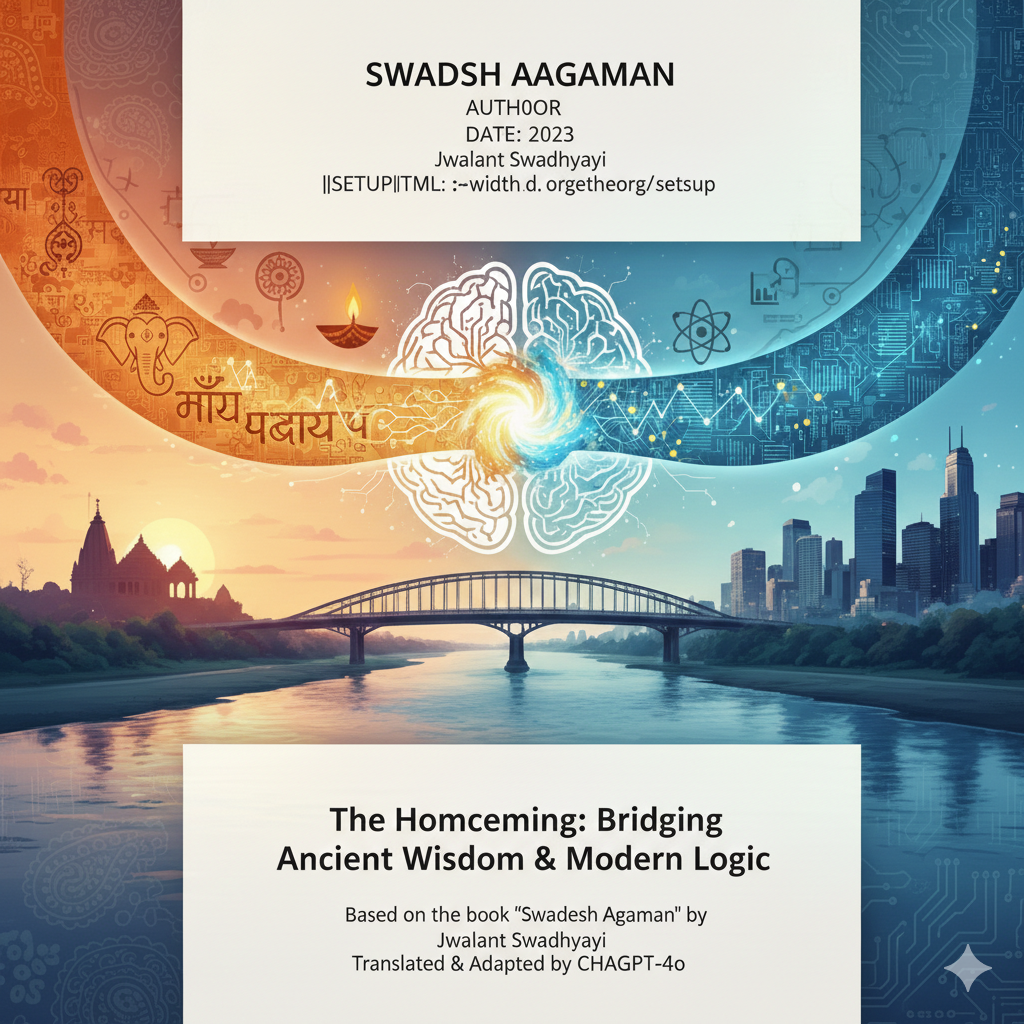
Swadesh Aagaman: The Homecoming
Table of Contents
- Styling Configurations
- [Cover Page]
- Formatting Tips for Your Tables
- Formatting Tips for Your Images
- Preface: The Logic of Heritage
- About the Translator & Project
- Table of Contents
- Chapter 1: Arrival in the Motherland
- Chapter 2: A Promise for the Pain
- Chapter 3: The Golden Period
- Chapter 4: The Question Paper
- Chapter 5: Adding Fuel to the Fire
- Chapter 6: Intensive Efforts
- Chapter 7: A Ray of Hope
- Chapter 8: The Meeting with Prakash
- Chapter 9: Yada Yada Hi Dharmasya (Chocolate Dharma)
- Chapter 10: The Driver and the Car
- Chapter 11: Good News
- Chapter 12: Sanskrit Non-Translatables
- Chapter 13: The Ten Characteristics of Dharma
- Chapter 14: The Traffic Signal of Life
- Chapter 15: The Cosmic Order (Ṛta)
- Chapter 16: The Ethical Filter
- Chapter 17: Inner Stability (Spirituality)
- Chapter 18: Universal Maturity
- Chapter 19: The Science of Rituals
- Chapter 20: The Vision (Conclusion)
- Epilogue: The Homecoming of Thoughts
- Appendix: Key Concepts from Arya's Journey
- Final Note: The Unending Quest
- Final Summary: Swadesh Aagaman (The Homecoming)
- Glossary of "Non-Translatables"
- Conclusion: The Promise Fulfilled
- Character Analysis: The Three Pillars of Change
- Final Closing Note
- Back Cover Blurb: The Bridge Between Two Worlds
- Bibliography: Foundational Sources & Influences
- Summary of Key Metaphors: The "Brain Bath" Matrix
Styling Configurations
—
[Cover Page]
—
Formatting Tips for Your Tables
| Metaphor | Story / Image | Philosophical Equivalent |
|---|---|---|
| … | … | … |
—
Formatting Tips for Your Images
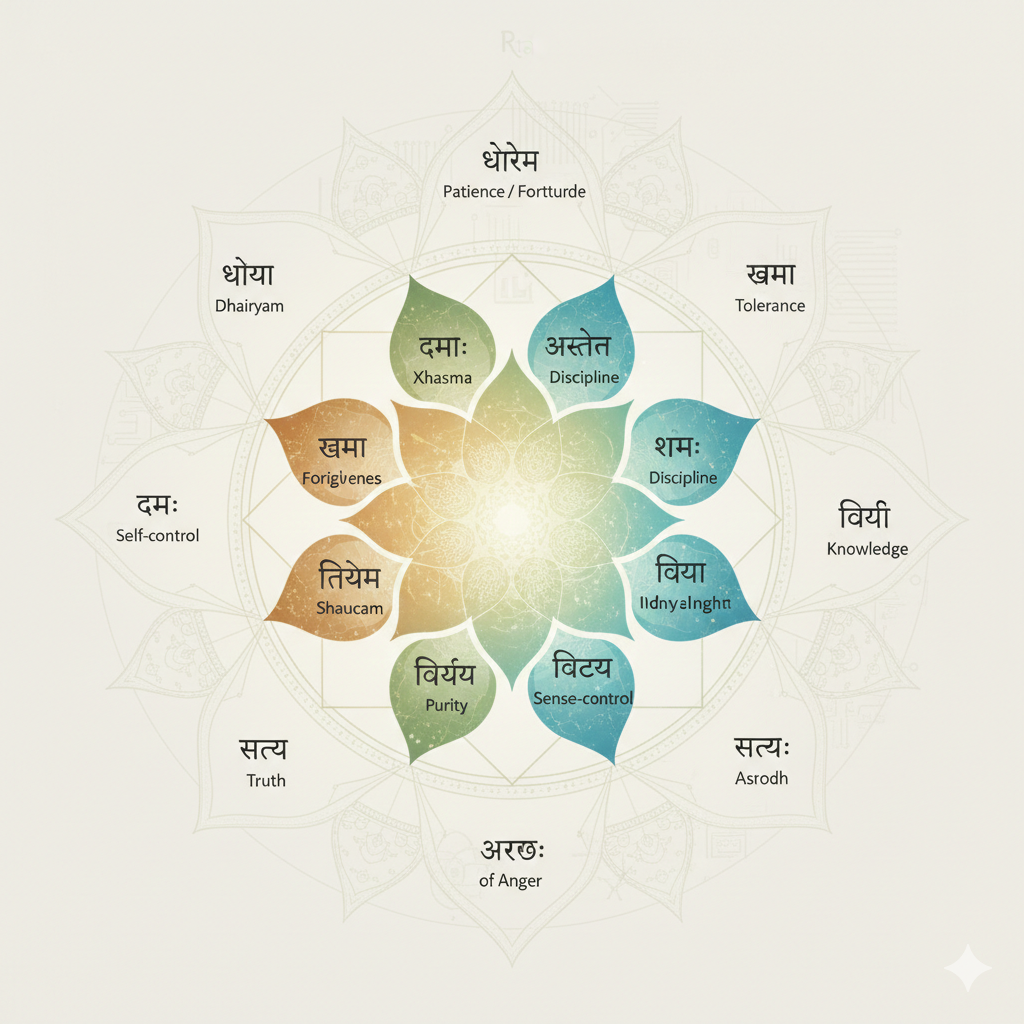
Figure 1: The Ten Attributes of Dharma from Manusmriti
Preface: The Logic of Heritage
This digital edition of Swadesh Aagaman was born out of a desire to bridge the gap between traditional wisdom and modern inquiry. In an age where information is abundant but understanding is scarce, the story of Arya and Prakash serves as a vital case study in intellectual honesty.
The goal of this translation and adaptation is not to advocate for a specific religion, but to showcase a methodology of thinking—the "Brain Bath"—where questions are celebrated and logic is the final arbiter of truth. Whether you are a skeptic like Arya, a seeker like Prakash, or a parent like Jitu, these pages offer a framework for reconciling our ancient roots with our scientific future.
About the Translator & Project
This version was collaboratively developed and translated into English in 2026. The project utilized advanced AI collaboration to ensure that the nuanced philosophical terms—the "Non-Translatables"—retained their original depth while remaining accessible to a global audience.
- Original Work: Swadesh Aagaman by Jwalant Swadhyayi.
- Translation & Curation: Collaborative AI Effort.
- Design Philosophy: Minimalist, logic-driven, and scannable for the digital reader.
"To know your roots is to know your strength; to know your logic is to know your path."
Table of Contents
Introduction
- The context of the promise to Devshi Dada.
Part I: The Arrival & The Conflict
- Chapter 1: Arrival in the Motherland
- Chapter 2: A Promise for the Pain
- Chapter 3: The Golden Period
- Chapter 4: The Question Paper (The Ganesha Conflict)
Part II: The Crisis of Faith
- Chapter 5: Adding Fuel to the Fire (The Israel-Hamas Context)
- Chapter 6: Intensive Efforts (The Failure of Blind Faith)
- Chapter 7: A Ray of Hope
Part III: The Brain Bath (The Dialogues)
- Chapter 8: The Meeting with Prakash
- Chapter 9: The Chocolate Dharma
- Chapter 10: The Driver and the Car
- Chapter 11: Good News
- Chapter 12: Sanskrit Non-Translatables
- Chapter 13: The Ten Characteristics of Dharma
- Chapter 14: The Traffic Signal of Life
Part IV: Higher Philosophy
- Chapter 15: The Cosmic Order (Ṛta)
- Chapter 16: The Ethical Filter
- Chapter 17: Inner Stability (Spirituality)
- Chapter 18: Universal Maturity (Moksha)
Part V: Conclusion
- Chapter 19: The Science of Rituals
- Chapter 20: The Vision
Final Analysis
- Glossary of Non-Translatables
- Character Analysis: The Three Pillars
Chapter 1: Arrival in the Motherland
Arya stepped onto the tarmac at Surat airport after her long journey. Clutching her luggage in one hand and an espresso from the coffee shop in the other, she navigated toward the exit. The eighteen-hour flight from America to Surat had left her exhausted. She knew her grandfather would already be waiting for her at the arrival gate. Reaching the exit, she stretched her weary limbs and scanned the crowd.
Dada Dhirubhai was rushing toward her, a wide smile lighting up his face. As he approached, Arya immediately touched his feet in respect. "Dada, how do you stay so energetic at your age?" she asked with a grin. "My back is already killing me."
"It’s the sukhdi that does it, child," Dhirubhai replied with a chuckle, placing a hand on her head in blessing. "You can’t get that kind of strength from your coffees and burgers." He took the bags from her hands, and they made their way to the car.
Arya’s father, Dr. Jitubhai Patel, was originally from India but had made America his home for the last twenty years. Arya was born and raised there. Exceptionally bright, she had developed a deeply rational approach to life. She was a curious soul who scrutinized everything; simply accepting things because she was told to was not in her nature. Having just finished the 12th grade, she had come to India with the dream of pursuing further studies in the field of scientific research.
While Arya had visited India many times before, this trip was different. For her, it might have felt like just another visit, but for her father, her mother Dr. Hetalben, and her grandfather Dhirubhai, this journey had a very specific purpose. Amidst the joy of her arrival, a quiet anxiety lingered in their minds—would they succeed in the goal they had set for her? The entire family was waiting for this "test" to conclude, hoping for a positive outcome.
As soon as they settled into the car, Arya video-called her father.
"Dad, I've reached Surat! Dada was there to pick me up, and I'm in the car with him now. I ate on time during the flight, and no, I haven't had a single headache today," Arya said, the words tumbling out in one breath.
Jitubhai laughed on the other end. "No matter how old you get, I’m always going to worry, okay?"
"Stop worrying! Can I tell you something? Though, you probably won't like it," Arya said.
"Go ahead, tell me."
"Dad, there was an elderly gentleman sitting next to me on the flight. We talked a lot, and I found out he was an active member of a Rationalist group for twelve years. I asked him so many questions, and he actually added a few more to my own list! So, your 'tension' might have just increased a bit. I thought you should know…" Arya trailed off.
"Oh, that's no problem at all, beta," Jitubhai replied jokingly. "Now that you're on your way to meet my 'ultimate disciple,' I’m not worried at all."
Arya narrowed her eyes playfully. "Overconfidence can lead to disappointment, Dad. Keep your expectations low, and you'll be less let down."
"I have full faith in our Indian culture—and in my friend. Tell me, when are you planning to meet him?"
"I knew that was what you were really thinking about! See that, Dada? He’s in such a rush," she complained to her grandfather. "Dad, let me freshen up first. I'll go in a day or two. Let's see who wins—your trust or my truth?"
"Alright, beta. Go whenever you feel ready. Bye," Jitubhai said.
As she hung up, Arya rolled down the car window and breathed in the fresh early morning air. A faint, innocent smile played on her lips.
To understand why this trip was so significant for the rest of the family, we have to look into the past. The roots of this story lie with Jitubhai’s grandfather, Devshibhai—Arya’s great-grandfather. To understand the connection between a great-grandfather and a great-granddaughter who never met, we must travel back twenty-one years.
Chapter 2: A Promise for the Pain
Jitendra (Jitu) Patel, a brilliant and sharp student living in Surat, Gujarat, had just cleared his MBBS exams. He rushed home to share the news with his mother, father, grandfather, and grandmother. After delivering the happy news, Jitu bowed to his elders, receiving their blessings for his future studies and a long life.
A one-year internship was about to begin, and during this time, Jitu had to decide on his postgraduate (PG) path. There were many opinions on whether he should study in India or go abroad. Jitu had a strong desire to study overseas, but his longing to remain with his family was just as intense.
After two months, the decision was finally made: he would go abroad for his PG. The qualifying exams for overseas studies were difficult and often required multiple attempts. His father, Dhirubhai, was well-off, so the financial burden or a delay in admission wasn't a concern. Everyone was thrilled with the decision—except for Devshi Dada.
For several days, Devshi Dada’s behavior had changed. Looking at the expressions on his face, Dhirubhai could tell that his father found something unsettling about this decision.
One early morning, while Dada was performing his usual prayers and meditation, Dhirubhai saw an opportunity and joined him. When the meditation ended, Dhirubhai handed him a cup of tea and said, "Jitu has decided to go abroad. Bapuji, no one in our family has studied this much. It’s a matter of pride for us that Jitu is so educated… he’s going to be a great doctor."
Devshi Dada spoke in a soft, heavy voice. "Yes, one should definitely study. It’s wonderful that Jitu will be a great doctor. But after he finishes his studies, will he come back to his country, or will he stay there?"
"We haven't really thought about that yet, Bapuji."
"I've heard people say that children who go abroad end up staying there. Staying there isn't the problem, but eventually, their behavior and lifestyle become just like those people over there." Anxiety seeped into Devshi Dada's voice. "They lose their connection to the family. They turn away from our culture and religion. I've even heard some fall into bad habits and lose their way."
"You're right, Bapuji. I've heard those stories too. But our Jitu isn't like that. He’s very sensible," Dhirubhai reassured him.
The lines on Devshi Dada's face tightened. "Everyone is 'good' when they leave home, Dhiru. It’s only after they get there, dazzled by the environment and the luxury, that they change."
"Bapuji, why worry so much? Look, I'll ask Jitu to sit with you and talk about this, okay?"
Devshi Dada nodded in agreement.
That evening, after Jitu returned from his internship shift and finished dinner, Dhirubhai told him about his grandfather’s hesitations.
Hearing this, Jitu said, "Don't worry, Dad. Nothing can pull me away from our family or our culture. I wouldn't be able to live without them myself. Don't worry, I'll talk to Dada."
The next morning, as Devshi Dada went for his walk in the nearby garden, Jitu joined him. He told his grandfather about his internship and how his preparations for the overseas exams were going.
"That's very good. You are hardworking, so God will surely grant you skill, happiness, and prosperity," Dada said, blessing Jitu in his heart.
"Dada, my father told me about the conversation you had. Please don't worry. No matter where I go or where I live, I will never forget the values and upbringing you all have given me. I may breathe the air of a foreign land, but I will remain entirely Indian at heart," Jitu said, trying to ease his grandfather’s fears.
"That's wonderful to hear. To be honest, I'm not that worried about you. I'll be very happy if you find a wife who is as educated as you are but also understands our culture."
Sitting on a garden bench, Jitu asked, "Then what is it that worries you?"
Devshi Dada sat cross-legged and said, "Whatever God wills shall happen; worrying doesn't change anything. But I wonder… when you and your wife both go to work in that foreign culture, who will raise your children? We were here to shape you and give you values, but what if your children aren't given that foundation there? I've heard that our children stop being our own."
"Your concern is valid, Dada," Jitu said, taking his grandfather’s hand in his. "I will keep your words in mind and raise the next generation in such a way that they never forget our culture, traditions, and religion. Don't worry, I will make sure they are raised with strong values."
For the first time in days, a sense of peace settled on Devshi Dada’s face. The grandfather and grandson took a few more laps around the garden and headed home. Dhirubhai, hearing about the discussion later, was overjoyed and felt a deep sense of pride in having such a sensible son.
On the other hand, the search for a suitable life partner for Jitu had begun as soon as he passed his MBBS. While choosing a partner, Jitu kept the promise he had made to his grandfather in mind. He insisted on finding someone who could balance a career with managing a home and providing a cultural upbringing for their children.
By the time he was six months into his internship, Jitu became engaged to Hetal, a physiotherapist. They planned to marry four months later. As they grew closer, Jitu found the right moment to tell Hetal about the promise he had made to his grandfather. Hetal accepted it wholeheartedly and agreed to help him fulfill his resolve.
Jitu and Hetal were married in a grand ceremony. As his internship drew to a close, Jitu passed the required exams and applied for admission in America. The results were positive, and plans were made for Jitu and Hetal to move to America for his PG studies two months later.
During this period, Devshi Dada’s health took a turn for the worse, and he was admitted to the ICU. Even at ninety-six, he had remained strong in spirit, but he was now approaching the sunset of his life. Being a doctor, Jitu knew from the reports that his grandfather didn't have much time left. He spent as much time as possible by his side, repeatedly reminding him of the promise he had made to keep him at peace.
Dada listened to Jitu’s words with a sense of fulfillment. Within seven days, he closed his eyes and drifted into eternal sleep. After completing the funeral rites and other ceremonies, Jitu left for America with his wife Hetal and his parents' blessings to begin his further studies.
Chapter 3: The Golden Period
In America, Jitu’s three-year residency in Internal Medicine began. Hetal, too, secured a good job in her field. Alongside their careers, the couple moved forward with their personal lives.
Five years had passed since Jitu and Hetal moved to the States. Jitu had completed his PG and was working at a hospital, while Hetal was thriving in her profession. During this time, their small family grew; they became parents to two children. Their eldest daughter, Arya, was now three years old, and their son, Aarav, was just three months old. Both Jitu and Hetal vividly remembered the promise made to Devshi Dada. Consequently, during her pregnancies, Hetal had made a sincere effort to study and practice Garbh Sanskar (womb-education). They took special care to ensure the children’s upbringing followed Indian cultural traditions.
Despite being far from their homeland, they celebrated every Indian festival with great fervor so the children would stay connected to their roots. Weekend visits to the temple and watching series like Ramayana and Mahabharata with the kids became a routine. Every morning and evening, lamps were lit in the family shrine, and every Saturday, the whole family sat together to recite the Hanuman Chalisa. Jitu remained fully alert, putting in every effort to ensure they didn't stray from the vow he had given.
As time slipped by, Arya and Aarav grew older. The children became talkative and asked innocent questions that often made Jitu and Hetal laugh. They began going out to play and attend school. Jitu and Hetal had instilled the habit of saying "Jai Shri Krishna" whenever they left, returned, woke up, or went to bed. However, because Arya played with American neighbors and attended a local school, she occasionally said "Good Morning" instead of "Jai Shri Krishna" due to the surrounding culture. Whenever she did, Hetal would respond with "Jai Shri Krishna."
One day, Arya asked out of curiosity, "Everyone says 'Good Morning' in the morning, so why do we say 'Jai Shri Krishna'? It's morning, so shouldn't we say 'Good Morning'?"
Arya’s question was valid, but treating it as a childhood curiosity, Hetal explained, "The people in America follow their tradition and say 'Good Morning,' and we follow our Indian tradition by saying 'Jai Shri Krishna'."
At that moment, five-year-old Aarav piped up, "Who is this 'Tradition'? Does he live in both America and India?"
Hetal burst out laughing. "You ask your father that when he gets home."
The children enjoyed their childhood filled with such curious exchanges. Jitu and Hetal also found great joy in raising them. The parents made it a point to visit India every one or two years—a rule they strictly followed so that the touch of Indian traditions, culture, and festivals would remain fresh in the children's minds.
In this manner, twelve years passed smoothly. Arya was now entering her "Sweet Sixteen" phase, and Aarav was thirteen. Both attended school regularly and played in the neighborhood and parks. They learned many new things and immediately asked questions about anything they didn't understand. They began comparing options to see which was better. If an idea or thought didn't sit right with their logic, they would fire off numerous questions. They only accepted and practiced something if they received a satisfying answer. Doing something just because "everyone else does it" was simply not in their nature.
Chapter 4: The Question Paper
With the Ganesh festival approaching, Jitu and Hetal were driving the children to the market to buy an idol of Lord Ganesha. On the way, Arya asked a question.
"Mom, when I went to India last vacation, I heard a story about Ganesha from Dadi. She said that once, Mahadev came home feeling very angry. Parvati Mata was taking a bath at the time. Ganesha blocked him from entering, so Mahadev cut off his head and went inside. Later, when Parvati Mata saw her son’s headless body, she asked Mahadev, 'This was our son, and you killed him?' Then Mahadev threw his trident, brought back an elephant's head, and fitted it onto Ganesha's body. That's why Ganesha has a human body but an elephant head. Is this story right, Mom?"
"Yes beta, I told you that story myself when you were little," Hetal replied.
Before Jitu could say anything, Aarav chimed in, "How can an elephant’s head fit on a human body? That head is so huge! If someone put an elephant head on me, I wouldn't even be able to look up."
"Don't joke, I seriously want to know," Arya said, sounding annoyed.
"I'm asking seriously too!" Aarav shot back.
"Wait, the head-fitting comes later; there’s something fishy about the beginning of the story. Dad, can I ask you a question?" Arya turned toward her father.
Jitu said while driving, "Yes beta, go ahead."
"If Mom was taking a bath at home and you came home for some emergency work and I stopped you saying 'Mom is bathing,' what would you do?"
"I would wait for a while," Jitu answered.
Arya asked again, "But what if there wasn't time to wait?"
"Then I would move you aside."
"If I stopped you, would you kill me?" Arya asked point-blank.
Jitu replied, "No, I wouldn't even dream of that. I can't even bring myself to slap you."
Arya’s questions weren't ending. "If some other girl or boy stopped you instead of me, would you kill them?"
"No, absolutely not."
Hetal watched the dialogue between father and daughter, wondering what Arya’s next question would be and how they would answer it. Aarav was listening with curiosity as well.
Arya spoke up happily, "Perfect! You are my good Daddy. If you, as a sensible person, wouldn't kill anyone, then why would Mahadev—the God of Gods—kill Ganesha over such a small matter?"
Jitu and Hetal were stunned into silence. They celebrated the Ganesh festival every year with great devotion and pomp, but they had never looked at it through such a logical lens.
Jitu tried to cover some ground. "Even if he killed him, he brought Ganesha back to life, didn't he?"
Arya wasn't ready to accept that. "But what about the other elephant he killed for that? That elephant's life was lost, right?"
Jitu and Hetal looked at each other. Neither knew what to say.
"You usually talk about 'humanity' whenever you discuss our Hindu religion. So, where is the humanity in taking a life over a small reason, and then taking another life just to fix the mistake because you realized it was your own son? Where is the humanity in that, Dad?" Arya spoke with a hint of frustration.
Hetal and Jitu had no answers for Arya and Aarav. They hoped they would reach the market quickly so they could change the subject and get the kids busy with shopping. The market was close, but the conversation had to continue until they parked.
Hetal tried to pivot. "Anyway children, tell me—how big an idol should we get?"
Aarav answered innocently, "One that fits in our home shrine."
Arya, however, spoke as if she had already made up her mind. "You guys decide that. First, I want to know: Why should I pray to Ganesha? Why should I believe in Mahadev? If we are more sensible than they are, why should we consider them great?"
Jitu could understand the turmoil in Arya's mind, yet he felt helpless because he didn't have precise, logical answers for the questions swarming in her head.
Aarav saw an opportunity too. "Yeah Arya, even at school, a friend was telling me, 'You guys believe in an Elephant God, a Monkey God, a Tree God—so many gods—and on the other hand, you say God is one!'"
By the time they finished talking, they reached the shopping mall, and Jitu and Hetal felt a bit relieved. After parking, buying the Ganesha idol, and finishing other errands, they went to a restaurant for dinner. Once Arya and Aarav got their favorite food, their minds were occupied for a while.
But there was no peace in Jitu’s mind. He had to install the Ganesha idol at home for ten days, and he knew these questions would surface again. If he didn't provide proper answers, the new generation wouldn't follow the traditions. Right there at the table, Jitu searched Google and asked a few friends on WhatsApp, but he didn't find a satisfying answer. One friend sent him some photos of pages from a book. By the time they finished eating and got back to the car, Jitu had read them.
On the way back, Jitu tried to explain based on what he had read.
"Arya, Ganesha represents the qualities of a leader. Gan means a group and Pati means the manager or leader; thus, Ganpati is the leader of a group. A leader should have certain qualities, like listening to everyone, having a sharp vision…"
Arya interrupted him mid-sentence. "That isn't my question. My question is: How could Mahadev commit a murder? If you wanted to show leadership qualities, what was the need for this story? You could just explain it using a baby elephant directly, right? I know you're searching Google and telling me this. I've already read that leadership stuff."
On one hand, Hetal and Jitu were happy to see their daughter's intense curiosity; on the other, they felt a pang of regret for not being able to give her a satisfying answer.
"Whatever it is, the festival is a lot of fun. I love playing the drums, doing the Aarti, and eating the Prasad," Aarav shared his view.
Hetal explained to Arya, "See beta, look how Aarav sees the positive. We should also have a positive outlook and ignore what we don't understand."
"I enjoy the festival too, I'm not denying that. But if this is how it is, there shouldn't be any direct or indirect force to celebrate the festival or follow the tradition," Arya stated clearly.
Jitu felt there was no point in forcing her or arguing further. He said, "There's no force, beta. Do whatever feels right to you. Okay?"
From then on, Arya acted very indifferently during the Ganesh festival. Previously, she used to decorate the idol happily of her own accord, but now she stopped doing all of that. Jitu watched the effect that unanswered questions had on a child's mind. Until now, he had always encouraged his children to ask questions, but today, for the first time, he felt a sense of helplessness. Because he lacked the right knowledge himself, he couldn't nourish Arya’s curiosity.
Understanding a child's mind is difficult; it is even harder to resolve their questions to their satisfaction. What are children if not tender saplings? They will bend whichever way you train them. Perhaps the greatest lesson of parenting is that a child should be able to ask questions without hesitation. Home should be the place where their questions are not suppressed. They might get answers through lies or tall tales, but their quest for the truth will continue. It is necessary for a healthy and progressive society that every child questions tradition, and it is equally necessary that parents bring the truth of those traditions before them.
Chapter 5: Adding Fuel to the Fire
About a month after the Ganesh festival, war broke out in Israel between the military and the Hamas organization. The people of Israel were Jews and those of Hamas were Muslims. In this fight in the name of religion, countless innocent children and women were dying. News of this war was being discussed everywhere. Arya and Aarav were also learning a lot about this through social media and TV news. While everyone was sitting together, Arya asked a question.
"Religion is supposed to be a good thing, right? It should make people live in peace. But look at how much unrest there is in the world in the name of religion. Compared to this, the countries that don't believe in religion or God seem to live much more peacefully."
Jitu said, "Your observation is very deep, Arya, and your point is true as well."
"So, is it necessary to follow religion or believe in God? If we don't believe in it and don't follow anything like that, would we face any trouble or loss?" Arya asked with great innocence.
Jitu joked, "If we don't follow it, we won't get into heaven; we'll have to go to hell."
Arya argued, "Come on Dad, those are all things that happen after death. How do we even know if any of that exists? What about while we are alive right now? That is what's visible, so religion or God should have some use or benefit in relation to that!"
While these conversations were going on, new reports arrived stating that terrorists in India's Kashmir had killed 28 innocent people. The terrorists asked the people their religion, and those who were not Muslim were shot and killed in front of everyone.
Hearing this news, Jitu and Hetal immediately realized that fuel had been added to the fire. Now, the fire of Arya's questions was going to burn even more intensely. However, Arya showed a contrary attitude. She stopped asking her parents questions altogether because, in the discussions so far, she hadn't received proper answers. Therefore, regarding this subject, Arya no longer expected a precise answer from her parents.
Arya now began searching for her answers on the internet and via AI. She learned that besides the current wars, many wars had been fought in the name of religion in the past. In religious wars like the Crusades and the Thirty Years' War, countless people were killed. In Indian history as well, hundreds of people died in the religious wars of the Ramayana and Mahabharata. Knowing all this, Arya began to feel a sense of hatred toward religion, but she still wanted to know more. She didn't want to make an immature decision, so she continued her research.
Arya discovered that in India and other countries, a lot of superstition is spread in the name of religion. In temples, VIP people give money to get darshan faster, while there are long lines for common people. A very large illegal exchange of money also takes place in the name of religion. Between rituals, astrology, threads and charms, sacrificial fires, and exorcism, it has become difficult to find what is true and what is false. Being religious seems to be just a matter of show, and everyone treats their own religion as great while performing fanatical acts to pull down the religions of others.
Arya would often discuss this with one of her teachers, Vivek Shah. Vivek was originally from India and held a rationalist viewpoint. After her research, Arya put many questions before him. Vivek Sir listened to everything peacefully and then told Arya:
"Arya, religion is a system to keep people under control through fear and temptation. Some power-hungry people created this religion so that people stay occupied in it." Giving a reference, he further stated, "Look, Karl Marx, the father of communism, says that 'Religion is the opium of the people.' People stay immersed in it, and for a short time, they feel an unrealistic experience of their pain going away, but it makes no difference in real life."
These words generated even more questions in Arya's mind. Right now, her mind was swinging from one end to the other. In the struggle between what is right and what is wrong, her mind was acting just like a scientist's. On one hand, the lessons of culture her parents had given her all these years stood before her, which felt like her own. Yet, on the other hand, a completely new contradiction had arisen in her mind. "Was everything I was told and taught until now wrong?" This question increased her restlessness.
Chapter 6: Intensive Efforts
Arya began observing the people around her with a new awareness. She noticed that Dharmesh Uncle, who came to the sports club with her Dad, doesn't believe in any religion, yet he is very good. She had heard many stories of his honesty from her Dad, and he kept helping the poor financially. On the other hand, a person working in management at her Dad's hospital had cheated regarding money at the job, but he was fundamentally religious and involved in many religious activities. She saw some good, sensible, and honest people—like her Dad—who had great faith in religion, but Arya felt that if perhaps they didn't believe in religion, they would still be just as good. They were likely following religious customs only as part of a tradition.
At the end of this mental "churning of the ocean," Arya reached a decision: religion is a sham, nothing else. It has more disadvantages than advantages. Even so, anyone who wants to follow it may do so, but there should be no direct or indirect pressure. Following it should be entirely optional and, if possible, there should be some understandable reason behind the following that is happening. If someone starts doing something just because everyone else does it, that is not tradition, but superstition.
Arya shared this decision with Jitu and Hetal in the presence of Aarav, citing the references she had studied.
Hetal and Jitu's worry increased. Looking at the photo of Dada kept in the house, Jitu was engulfed in the worry of whether the promise given to Dada years ago could be fulfilled or not. Because of Arya's decision, 13-year-old Aarav's mind was also passing through these same ideological whirlpools. Thus, Jitu and Hetal's worry doubled.
Jitu had never forgotten the promise given to Dada. He had also taken Hetal's consent regarding this promise. Both together had kept every festival, custom, tradition, and daily routine in such a way that the children received a full cultural environment. There was no lack of sincerity or effort, yet this situation had arisen, which signaled the parents to look back and reflect.
Jitu and Hetal used to go to the temple only occasionally. Now, to improve this situation and fulfill the promise given to Dada, they began going to the temple regularly and participating in all its programs.
They would take Arya and Aarav along for every activity at the temple. Earlier, they went to the temple for a casual visit; now, there was a specific purpose for going. Instead of just taking darshan, Jitu and Hetal took more interest in understanding the purpose and logic behind all the traditions and beliefs. On the other hand, in Arya and Aarav's minds, the temple was now just a place to hang out and for entertainment. They no longer had any goodwill toward religion or culture. They were putting on an outward appearance only as much as was necessary to make their parents feel good.
On one such day, while going to a Satsang assembly, Jitu told Arya and Aarav:
"Arya, Aarav, today we are going to a Satsang assembly. You can ask whatever questions you have there."
"You don't have any questions? I've asked so many questions; you just ask whichever ones you think are fine, and we will listen to the answer," Arya replied indifferently.
"Fine, come on, I will ask myself," Jitu said happily.
Upon reaching the Satsang, all three took their places. The speaker delivering the Satsang was talking about the importance of religion and devotion. Every listener present in the hall was listening to it peacefully. Jitu had kept questions ready in his mind. Today, a hope was born in his mind that perhaps the problems would be resolved today. As soon as the Satsang ended, Jitu asked a question.
"Namaste Sir, my question is about the relationship between Ganesha and Shiva. I wonder why Shiva, in a fit of rage, cut off Ganesha's head? Was that appropriate? And if he could reattach a head, why instead of reattaching the same severed head, did he cut off an elephant's head—committing another murder—and attach that head?"
This question was unexpected for the speaker. "Brother, this is not our subject today, and this temple works for Krishna devotion. If you have any questions regarding that, please let me know," he said.
"Fine, let me ask about that. If religion is very important according to Krishna, then what do you have to say about Karl Marx saying 'Religion is an opium'?" Jitu asked the question.
"Is Karl Marx greater or Krishna? It seems you don't have faith in Krishna," the speaker spoke irritably.
Jitu said very lovingly, "There is faith in Krishna, that's why we come to the temple."
"If there were faith, this question wouldn't have arisen. Increase your faith, and the answer will be found automatically." Saying this, the speaker turned back to listen to another listener's question.
Jitu looked at Arya; she was also looking at Jitu. Today, Jitu could not meet his daughter's gaze and looked down. His hope had turned into disappointment.
After coming home, Arya told the whole story to Hetal. She described in detail how Dad asked the questions and how the speaker, instead of giving an answer, raised questions about Dad's faith itself.
"So Mom, if not having faith is our problem, then to know anything, we have to have faith from the start. If we have to have faith without knowing anything, then isn't that superstition?"
Hetal had no option but to say yes. "Your point is true, beta. After knowing and understanding something, if the trust increases, then only it is called faith." She looked at Jitu's sad face.
"This is like saying that, suppose Dad didn't cure a patient, or Dad made a mistake in the treatment, Dad could tell the patients that 'you probably didn't have faith in me, that's why you aren't getting better'," Arya said and started laughing.
"This has become a universal answer for any question. Just say there probably wasn't faith, and the job is done," Aarav also said, laughing.
Jitu and Hetal also laughed for a while, forgetting the sadness seeing the children's laughter.
Arya finished her point by saying, "Look, according to Pew Research figures, the number of 'religiously unaffiliated' people is increasing in the world, especially in European countries. This fact also points toward religion being unnecessary. People who believe in God are also decreasing, but the number of people moving away from religion is increasing very rapidly. Dad, it's not necessary that we do everything only for our faith; it's necessary to take decisions by thinking a bit rationally now."
The new generation was making the parents experience how deep their research could be, and Jitu and Hetal had no option but to agree.
As Jitu and Hetal tried to find a solution to the problem, the problem kept increasing. Forget the promise given to Dada, Jitu now felt himself that "Are we really on some wrong path?" because Arya's questions were very logical; there was no immaturity, passion, or feeling of hatred in them. They were indeed just simple questions asked to understand something. These were not questions asked to prove someone wrong or to nourish one's ego. These were just common questions that any sensible person could have.
Jitu and Hetal were also very bright and sensible. If they had enough time, they were capable of finding the answers to these questions, but in the current situation of worry and dilemma, they didn't understand what to do and what not to do.
Chapter 7: A Ray of Hope
Seeing no other way out, Jitu discussed the situation with his father, Dhirubhai. In a long conversation over the phone, Jitu poured his heart out about his worries, the promise made to Devshi Dada, and Arya’s relentless questioning.
"I’ve tried everything, Dad," Jitu confessed, his voice heavy with disappointment. "Hetal and I have done everything we could. From frequent trips to India to practicing our religious rituals, we gave them a complete cultural environment so they would understand the values of our heritage. But over time, questions arose in Arya and Aarav’s minds that we couldn't answer. It feels like all our hard work has gone down the drain."
Dhirubhai consoled him, "It’s not your fault, son. Even here in India, the situation with the new generation is the same. We often find ourselves speechless before the questions of today’s youth. You’ve done your best, so don't be so hard on yourself."
"But I feel terrible, Dad. If this generation forgets our culture, it won’t take long for them to lose their way. Our culture is our legacy. Money and luxuries can be earned anywhere, but if we don't understand our God, our religion, and our customs, then what is our identity? There is comfort everywhere, but peace is only in our roots," Jitu said anxiously.
Dhirubhai listened patiently. He understood the weight on Jitu's heart. After a long pause, an idea struck him. "Jitu, do one thing. Talk to your friend Prakash. I’ve heard that he and his wife are working on a unique educational system for children. They keep religious and cultural thoughts at the center of their teaching. He might definitely be able to help you."
"Yes, that’s true. Prakash keeps posting about it on Facebook," Jitu replied. "But he’s a bit stern. If I talk to him, he’ll probably get angry with me first."
"Why? Why would he be angry?"
"When we were studying together, he used to read a lot of books, especially on Indian philosophy. He used to nag me to read too, but I never paid attention to anything except my medical studies. Now I feel that if I had read even a little, I could have answered at least some of Arya’s questions," Jitu explained.
Dhirubhai said, "That’s alright. He’s still a very good friend of yours. He will surely show you a way. Arya is coming to India after this Diwali anyway, so we can arrange for her to meet Prakash if you think it's right."
"That sounds like a great plan, Dad. I'll talk to Prakash today."
Chapter 8: The Meeting with Prakash
Jitu called Prakash and explained the whole situation. As expected, Prakash teased him first about his lack of reading, but then he listened seriously to Arya’s dilemma.
"Jitu, your daughter isn't wrong," Prakash said calmly. "The problem isn't the child; it's the 'informational' way we present religion. We tell them what to do, but we never explain why. If Arya is coming to India, send her to me for a week. Tell her it’s a 'Brain Bath'—a chance to wash away the confusion with logic."
A few months later, Arya arrived in India. After spending a few days with her grandparents, she traveled to meet Prakash at his center. She was skeptical. She expected another priest-like figure who would tell her to "just have faith."
When she arrived, she saw a simple, modern-looking office filled with books. Prakash welcomed her not with a prayer, but with a question: "So, I heard you think Mahadev is a murderer?"
Arya was taken aback by his bluntness. "I didn't say that exactly, but the story is certainly illogical and violent," she challenged.
Prakash smiled and sat across from her. "Arya, do you know the difference between a 'fact' and a 'truth'? A fact is something that happens in time. A truth is a principle that is always true. Our Puranas are not history books; they are maps for the human mind. They use 'symbolic language' because the human brain remembers stories better than dry philosophy."
He took a piece of paper and drew a human figure with an elephant head. "Let's look at the Ganesha story again, but this time, through the lens of psychology and leadership. Shiva represents the 'Pure Consciousness.' Parvati represents 'Creative Energy.' Ganesha, born of Parvati, represents the 'Ego' or the 'Individual Intellect' created by our worldly energy."
Arya listened, her skepticism slightly wavering.
"When Shiva—the Pure Consciousness—returns, the Ego (Ganesha) blocks the way. The Ego thinks it knows everything and refuses to let the Higher Truth enter. Therefore, the 'head' of the Ego must be removed for a person to progress. But why an elephant head?"
Prakash looked at her intently. "An elephant has unique qualities: big ears to listen more, a small mouth to talk less, and most importantly, a 'Vishal Buddhi'—a massive, broad intellect. By placing an elephant's head on a human body, the story tells us that a true leader must replace their small, selfish human ego with a broad, wise, and all-encompassing intellect."
Arya sat in silence for a moment. This was the first time someone hadn't told her to "just believe."
"So… it’s a metaphor?" she asked softly.
"Exactly," Prakash replied. "In India, we call it Rupak. It’s a way to teach a complex psychological transformation to common people. But over centuries, people forgot the meaning and started worshiping the story literally. Your father saw the 'Chocolates' of religion, but I want to show you the 'Nutrition' behind it."
Arya felt a spark of interest she hadn't felt in a long time. "Okay, Uncle. You called this a 'Brain Bath.' I’m ready for the next lesson."
Chapter 9: Yada Yada Hi Dharmasya (Chocolate Dharma)
After Arya spent some time exploring Prakash’s library, she noticed a mix of religious texts alongside books on psychology, science, and history. [citestart]Taking out a copy of the Bhagavad Gita, she reignited the conversation. [cite: 184, 185, 186]
[citestart]"Is it really necessary to believe in religion?" she asked, citing the wars fought in its name and Karl Marx’s famous quote that 'religion is the opium of the people.' [cite: 187, 189] [citestart]She even showed him a Pew Research article about the decline of religious affiliation. [cite: 190]
[citestart]Prakash complimented her scientific temperament but challenged her to look deeper. [cite: 191, 193] [citestart]Later, his wife Beejal explained a concept that shifted Arya's perspective: "Chocolate Dharma." [cite: 368]
- [citestart]**The Logic:** Beejal explained that just as a parent gives a child a chocolate to encourage them to go to school, wise sages used "unrealistic temptations" to guide immature minds toward a disciplined life. [cite: 368]
- [citestart]**The Application:** For instance, the promise that "simply remembering a name washes away all sins" is a 'chocolate' for those who aren't yet ready for deep philosophy. [cite: 368]
- The Realization: Arya’s eyes lit up. [citestart]She realized that for an evolved person, the goal is the discipline and values (the nutrition), while the literal lures are just tools for the less-evolved. [cite: 368, 369]
Chapter 10: The Driver and the Car
The discussion then turned to the practical impact of religion on society. [citestart]Arya questioned why "humanity" wasn't enough to solve the world's problems. [cite: 16, 17] [citestart]Prakash used a multi-factorial example to explain social stability. [cite: 311, 312]
- [citestart]**The Metaphor:** He compared the human body to a car and the human mind to the driver. [cite: 531, 532]
- [citestart]**Accidents in Society:** Social issues like crime, corruption, and instability are the "accidents." [cite: 395]
- The Solution: Prakash asked what prevents an accident—is it servicing the car or training the driver? [citestart]Arya understood that while humanity "services the car" (by feeding the hungry or treating the sick), true Dharma "trains the driver" (by disciplining the mind and ego). [cite: 395]
- [citestart]**Science vs. Religion:** Prakash noted, "Science gives speed, but Dharma gives direction. Speed without direction leads to accidents." [cite: 395]
[citestart]Arya began to see that Dharma is not a set of restrictive rules but a "moral filter" for humanity. [cite: 394, 395] By the end of this exchange, she felt a newfound clarity. "I used to run away from religion because it looked like a mess," she admitted. [citestart]"Now I see the mess wasn't in religion, it was in my understanding." [cite: 517]
Chapter 11: Good News
Upon returning home, Arya immediately called her father. [citestart]Although it was night in India, she knew the day was just beginning in America and she could speak to everyone[cite: 210]. [citestart]She was eager to hear her father's voice after a day filled with intense discussions, questions, and new ideas[cite: 211].
[citestart]As soon as he picked up, Arya said, "Sorry Dad, I missed your calls because we were in the middle of a very important discussion"[cite: 212]. [citestart]Jitu joked, "Yes, I spoke to your Grandpa and he mentioned it. How is my disciple Prakash doing? Is he teaching you properly?"[cite: 213]. [citestart]They both laughed, and Arya replied confidently, "Your disciple has actually surpassed the master"[cite: 214]. [citestart]Jitu quipped, "That just means I taught him well"[cite: 215].
[citestart]Arya then spoke to her mother, Hetal, who was in a car on her way to an ISKCON temple[cite: 217]. [citestart]When asked about her dialogue with Prakash, Arya responded with enthusiasm, "It's going great! I learned so much today"[cite: 218]. [citestart]After a brief exchange, they bid each other goodnight, with Jitu and Hetal feeling much more relaxed after hearing the renewed confidence in Arya's voice[cite: 220, 221]. [citestart]Her trip to India was no longer just a vacation; it had become a transformative, hopeful experience for the whole family[cite: 222].
[citestart]That night, Arya fell into a deep sleep while reflecting on the answers she had received[cite: 223]. [citestart]She had a strange dream about unknown people trying to sell her things while hiding something from her[cite: 224, 225]. [citestart]She woke up early the next morning with even more curiosity and a burning desire to learn more[cite: 227]. [citestart]After a breakfast of bataka pouwa with her grandparents, she headed back to Prakash's house[cite: 228, 229].
Chapter 12: Sanskrit Non-Translatables
[citestart]When Arya arrived, Prakash was about to leave for a surgery that would take about two hours[cite: 231]. [citestart]He invited her to wait in his library and study anything she liked[cite: 232]. [citestart]When Arya asked for a recommendation, Prakash left a specific book on the table for her: Sanskrit Non-Translatables by Rajiv Malhotra[cite: 234, 235].
[citestart]The book discussed how the meanings of many Sanskrit words change—and are often lost—when translated into other languages, especially English[cite: 235]. [citestart]It specifically addressed the misunderstandings created by equating the word 'Dharma' with 'Religion'[cite: 235]. [citestart]Arya became deeply engrossed and managed to finish two chapters before Prakash returned[cite: 235].
[citestart]"Prakash Uncle," Arya said as soon as he arrived, "studying this book made me realize that a culture should be studied through its own language and the perspective of its own people"[cite: 236]. Prakash was pleased. [citestart]"Exactly. That is why I suggested it"[cite: 237].
[citestart]Arya then showed him a verse from the Manusmriti she had written down on a piece of paper, which listed the ten characteristics of Dharma[cite: 239]. She wanted to delve deeper into how these ancient principles applied to the modern, logical world she lived in. Prakash sat down, ready to bridge the gap between ancient wisdom and her scientific temperament.
Chapter 13: The Ten Characteristics of Dharma
Arya sat with Prakash, holding the list she had compiled from her reading. "Prakash Uncle, the Manusmriti lists ten characteristics of Dharma: Patience, Forgiveness, Self-control, Honesty, Purity, Sense-control, Wisdom, Knowledge, Truth, and Absence of Anger. These sound like universal human values. If these define Dharma, then anyone who follows them is 'religious,' regardless of their label, right?"
"Precisely, Arya," Prakash replied. "This is why the word 'Religion' is a poor translation for 'Dharma.' Religion often implies a specific belief system or a club you belong to. But Dharma is a code of conduct. If a scientist is honest in his research, he is practicing the Dharma of a scientist. If a leader is patient and truthful, he is practicing the Dharma of a leader."
Arya looked thoughtful. "So, when my Dad says he wants me to be 'religious,' he shouldn't mean he wants me to just perform rituals, but rather that he wants me to embody these ten qualities?"
"Exactly. Rituals are just the 'packaging.' The qualities are the 'product.' Most people fight over the packaging and forget to use the product. If you have patience and truth but don't go to a temple, you are more 'Dharmic' than someone who goes to a temple every day but is full of anger and lies."
Chapter 14: The Traffic Signal of Life
"But Uncle," Arya countered, "if Dharma is just about being a good person, why do we need all these complicated rules and scriptures? Can't we just use our common sense?"
Prakash decided to use a metaphor she would relate to from her life in America. "Arya, imagine you are driving on a busy highway in Los Angeles. Why do we have traffic lights and lane markings? Don't they 'restrict' your freedom to drive wherever you want?"
"No," Arya replied quickly. "They actually give me the freedom to drive safely. Without them, there would be a massive pile-up, and no one would get anywhere."
"That is exactly what Dharma is," Prakash explained. "Dharma is the 'Traffic System' of human society. It feels like a restriction, but it is actually a safety mechanism. When we follow 'Satya' (Truth) or 'Asteya' (Non-stealing), we are simply staying in our lane. If everyone decides to ignore the 'signals' of morality, society crashes. Science gives you the high-speed car, but Dharma provides the road map and the traffic rules so you don't destroy yourself or others."
Arya smiled, finally seeing the connection between ancient rules and social engineering. "So, following Dharma isn't about pleasing a God; it's about not crashing the car of society."
Chapter 15: The Cosmic Order (Ṛta)
After reviewing the ten characteristics of Dharma, Arya presented a new finding from her research. "Prakash Uncle, I read online that in the Rigveda, Dharma is closely linked to 'Ṛta'—the cosmic order or the laws of nature. It says the Dharma of fire is to burn and the Dharma of water is to cool. Is this different from the moral Dharma we discussed?"
Prakash nodded, impressed by her depth. "They are two sides of the same coin, Arya. Just as the physical universe follows laws (like gravity or thermodynamics) to remain stable, human society requires moral laws to remain stable. Ṛta is the natural order, and Dharma is the human alignment with that order. When we act against Dharma—by lying or stealing—we are essentially creating 'chaos' in the social order, just as a planet leaving its orbit would create chaos in the solar system."
Chapter 16: The Ethical Filter
Arya then raised a difficult question: "If science explains how the world works, why do we need Dharma to tell us how to live? Can't science solve our problems?"
"Science is a powerful tool, Arya, but it lacks a compass," Prakash explained. "Science can tell you how to split an atom, but it cannot tell you whether to use that energy to power a city or to destroy one. That is where Dharma comes in. Dharma acts as an 'Ethical Filter.' It asks: 'Does this action sustain society or destroy it?'"
He concluded with a powerful distinction: "Science gives us speed and capability, but Dharma gives us direction and purpose. Speed without direction is just a recipe for a faster accident." Arya began to see that religion, when stripped of superstition, was actually a sophisticated system of social and personal ethics designed to complement human progress.
Chapter 17: Inner Stability (Spirituality)
The next day, Arya arrived at Prakash's house with a new question. "Prakash Uncle, we've talked about Dharma as a social system. But what about the 'Self'? Many people talk about spirituality or 'Adhyatma.' Is that different from Dharma?"
Prakash used a medical analogy to explain. "Arya, imagine a body that only functions because of medicine. If you don't take the pill, the body fails. Is that body truly healthy?"
"No," Arya replied. "A healthy body should function on its own without external dependency."
"Similarly," Prakash explained, "most people's happiness depends on 'pills' like a big house, a high salary, or constant entertainment. If one of these is missing, their mental state collapses. This means their happiness is 'Vastunishth' (object-dependent). Spirituality is the journey from object-dependent happiness to 'Vasturahit' (object-independent) or 'Atmik' (soular) bliss."
Arya caught the essence: "So, just as a body running on pills is sick, a mind running on external conditions is also sick. Adhyatma is the medicine to make the mind independent and healthy."
Chapter 18: Universal Maturity
Prakash and Arya went for a morning walk in a nearby garden. The air was cool, and birds were chirping. They paused when they saw a small conflict at the playground.
One child pushed another off a swing so he could take it for himself. The child who fell began to cry, but the first boy didn't care; he was simply happy to be swinging.
"Look at that child," Prakash noted. "He is happy, but he is 'Immature.' His world is centered entirely on himself. He doesn't yet understand 'Paropkar' (altruism)."
Prakash then posed a question: "If that same child grows up and still pushes others aside just to get what he wants, what do we call him?"
"Selfish," Arya answered immediately.
"This is the core of 'Moksha' or Liberation," Prakash said. "People think Moksha is something that happens after death. But true Moksha is reaching a state of 'Universal Maturity' while alive. It is a stage where your 'ego-center' expands so much that you feel the pain of others as your own. A liberated soul is one who has graduated from the 'childish' mindset of 'me and mine' to the 'mature' mindset of 'everyone and ours.'"
Arya watched the children playing. The complex religious term "Moksha" suddenly felt like a logical developmental milestone for the human psyche. She realized that spiritual growth was simply the process of growing up—not just in years, but in consciousness.
Chapter 19: The Science of Rituals
As Arya prepared for her return to America, she had one final hurdle. "Prakash Uncle, I understand the philosophy now. But what about the rituals? Why do we light lamps, ring bells in temples, or perform 'Abhishek' with milk? Is there any logic there, or is that the 'Chocolate' part?"
Prakash smiled. "Rituals are the 'Physical Therapy' for the mind. Think of a laboratory. Why do scientists wear white coats and keep everything sterile? Does the white coat perform the experiment?"
"No," Arya said. "But it creates the right environment and mindset for precision."
"Exactly. Rituals are designed to engage your five senses and pull your focus away from the chaotic outside world toward the inner self. The bell's sound clears the mind, the lamp focuses the eyes, and the incense engages the breath. They are tools to create a 'Psychological Atmosphere.' If you do them with understanding, they are science; if you do them blindly, they are just habits."
Chapter 20: The Vision (Conclusion)
The week had come to an end. Arya stood at the airport, but she was not the same girl who had arrived. Her grandfather Dhirubhai and Prakash stood with her.
"So, Arya," Prakash asked, "did the 'Brain Bath' work?"
Arya hugged her grandfather and looked at Prakash. "I used to run away from Dharma because I thought it was a mess of myths and superstitions. I realize now that the mess wasn't in the Dharma; it was in my understanding. I am leaving with a new vision—not just information."
"Knowledge isn't just data, Arya," Prakash said. "Knowledge is a new set of eyes."
As she boarded her flight, Arya sent a message to her father's "Rationalist" friend: "I still have many questions about God, so you aren't off the hook yet! But for the first time, I feel like I'm heading in the right direction."
Back in America, Jitu and Hetal received the message and smiled. The promise made to Devshi Dada twenty-one years ago had finally been fulfilled—not through force, but through the light of logic and truth.
Epilogue: The Homecoming of Thoughts
Arya sat in her room back in America, her laptop open but her mind miles away in India. The bustling streets of Surat and the quiet, book-filled library of Prakash Uncle felt more real to her now than the familiar suburban silence of her neighborhood.
She looked at her father, Jitu, who was passing by her room. "Dad," she called out. "I've been thinking about the 'Traffic Signal' metaphor again."
Jitu stepped inside, a curious smile on his face. "And?"
"I realized that for years, I thought you were trying to give me a 'Speed Limit' by teaching me about culture. But now I see you were just trying to give me a GPS. Without it, I’d be driving fast toward nowhere."
Jitu felt a lump in his throat. He thought of his grandfather, Devshibhai, and the weight of the promise that had finally turned into a bridge of understanding. "I'm glad you found your signal, beta."
Appendix: Key Concepts from Arya's Journey
To keep track of her "Brain Bath" lessons, Arya created a quick-reference table in her notes:
| Concept | Literal/Misunderstood View | Logical/Dharmic View |
|---|---|---|
| Ganesha | An elephant-headed deity | Symbol of Ego-removal and Broad Intellect |
| Dharma | Religion/Sectarian Beliefs | Code of Conduct and Social Stability |
| Rituals | Superstitious habits | Psychological tools for focus (Sensory) |
| Moksha | Post-death salvation | State of Universal Maturity while alive |
| Spirituality | Running away from the world | Journey to object-independent happiness |
Final Note: The Unending Quest
The book concludes not with all answers found, but with a new way to ask questions. Arya realized that the greatest "Sanskar" (value) her parents gave her wasn't the rituals themselves, but the permission to seek the truth behind them. Her journey as a scientist and a seeker had truly just begun.
Final Summary: Swadesh Aagaman (The Homecoming)
The journey of Arya is a bridge between two worlds: the Ancient East and the Modern West. The story transitions from a conflict of "Blind Faith vs. Cold Logic" to a harmony of "Ancient Wisdom + Scientific Inquiry."
Core Themes:
- The Logic of Stories: Moving from literal interpretations of mythology (like the head of Ganesha) to psychological metaphors for human growth.
- Dharma as Social Science: Redefining religion not as a "club" for believers, but as a "Traffic System" that ensures social stability and prevents human "accidents."
- Maturity as Liberation: Redefining Moksha from a post-death reward to a state of living "Universal Maturity."
Glossary of "Non-Translatables"
This glossary lists the Gujarati and Sanskrit terms used throughout the text with their deeper philosophical meanings as explained by Prakash Uncle.
| Term | English Literal (Incorrect) | Dharmic Context (Correct) |
| :--- | :--- | :--- |
| Dharma | Religion | Sustenance; the laws that maintain social and cosmic order. |
| Sanskar | Habits / Customs | Psychological impressions; the "mental code" passed down through generations. |
| Moksha | Heaven / Salvation | Liberation from the ego; reaching a state of universal maturity. |
| Sukhdi | Sweet meat | Traditional energy food; a metaphor for the "strength of roots." |
| Adhyatma | Spirituality | The science of the self; the journey to object-independent happiness. |
| Rupak | Story / Myth | A metaphorical narrative used to explain complex psychological truths. |
| Abhishek | Bathing an idol | A sensory ritual designed to focus the mind through physical action. |
| Satya | Fact | Truth; that which is consistent with the cosmic order (Ṛta). |
Conclusion: The Promise Fulfilled
The story ends with the realization that the promise made to Devshi Dada was not about keeping Arya "Indian" by force, but about giving her the "Eyes of Wisdom." She returns to America not as a follower of a religion, but as a seeker of Dharma.
Character Analysis: The Three Pillars of Change
This section analyzes the psychological profiles of the main characters to explain how the generational bridge was successfully built.
1. Arya: The Rational Seeker Arya represents the modern, globalized youth. She is not "anti-religious" out of spite; she is "pro-logic."
- Internal Conflict: She struggles between her love for her family and her refusal to accept what she perceives as illogical myths.
- Transformation: Her arc is the most significant. She moves from cynical rejection (viewing stories as murders or superstitions) to intellectual appreciation (viewing stories as metaphors for psychology).
- Archetype: She is the "Skeptic Hero" who ensures that traditions remain living and breathing rather than stagnant and dusty.
2. Prakash Uncle: The Philosophical Bridge Prakash is the "ideal" teacher in the Dharmic tradition—one who welcomes questions rather than suppressing them.
- Approach: He uses the "Socratic Method," leading Arya to her own conclusions through metaphors she can relate to (traffic signals, cars, and medical surgeries).
- Role: He proves that one does not have to sacrifice their scientific temperament to be "Dharmic." He validates Arya's logic before adding a layer of wisdom to it.
- Archetype: The "Modern Sage" who speaks the language of the current generation.
3. Jitu: The Bridge-Builder (Parental Perspective) Jitu represents the "Sandwich Generation"—caught between the traditional expectations of his grandfather and the modern inquiries of his daughter.
- Conflict: His journey is fueled by a sense of duty (the promise to Devshi Dada) and a feeling of inadequacy when he realized he didn't have the answers his children needed.
- Resolution: He learns that being a parent isn't about having all the answers, but about finding the right environment and mentors for his children to seek their own truths.
—
Final Closing Note
This translation project is now complete. You have successfully converted the narrative from the Gujarati cultural context into a structured, logical, and accessible English Org-mode document.
"Knowledge is not just data; it is a new set of eyes." — Prakash Uncle
Back Cover Blurb: The Bridge Between Two Worlds
Can an ancient heritage survive a modern interrogation?
Arya is a "Sweet Sixteen" teenager born and raised in America—logical, scientific, and fiercely independent. Her father, Jitu, is a doctor driven by a sacred promise made to his grandfather: to keep his children rooted in their Indian culture.
But when Arya begins to dismantle centuries-old traditions with cold, hard logic, Jitu’s world collapses. From the "illogical" stories of Ganesha to the "violent" history of religious wars, Arya’s questions leave the elders speechless. Is religion just "opium for the people," as Karl Marx suggested? Or have we simply lost the key to its deeper meaning?
Enter Prakash: a man who doesn't ask Arya to "just have faith," but instead invites her to a "Brain Bath." Through a series of riveting dialogues, the ancient wisdom of the East is stripped of its superstitious husks. In this journey from the suburbs of New Jersey to the intellectual heart of India, Arya discovers that:
- Dharma is not a set of shackles, but a traffic signal for a safe life.
- Rituals are not blind habits, but psychological technology.
- Moksha is not a post-death reward, but a graduation into mental maturity.
"Swadesh Aagaman" is more than a story of a vacation; it is a roadmap for any parent, seeker, or skeptic looking to bridge the gap between the laboratory and the temple. It is a testament to the fact that when tradition meets truth, it doesn't break—it shines.
Bibliography: Foundational Sources & Influences
The following works provided the intellectual framework for Prakash Uncle's "Brain Bath" and are recommended for readers seeking a deeper understanding of the logic presented in Swadesh Aagaman.
1. Sanskrit Non-Translatables - Rajiv Malhotra & Satyanarayana Dasa Babaji
- This work is the primary inspiration for Chapter 12. It explores how translating terms like Dharma into Religion or Atman into Soul strips the original concepts of their scientific and psychological depth.
2. The Bhagavad Gita
- Referenced throughout the text as the source for the "Driver and the Car" metaphor (originally found in the Katha Upanishad but popularized in Gita commentaries) and the concept of performing duty without ego.
3. Manusmriti (The Laws of Manu)
- Specifically the section on the Dashakam Dharmalakshanam (The Ten Characteristics of Dharma), which Prakash uses to move Arya away from sectarianism toward universal ethics.
4. The Works of Karl Marx
- Cited by Arya in her critique of religion (the "Opium of the People" quote), serving as the catalyst for the "Chocolate Dharma" counter-argument.
5. Pew Research Center - Religious Landscape Studies
- The source for Arya’s statistical arguments regarding the decline of religious affiliation in the West.
—
Summary of Key Metaphors: The "Brain Bath" Matrix
Prakash Uncle used these analogies to bridge the gap between ancient concepts and Arya’s modern, logical mind.
| Metaphor | Story / Image | Philosophical Equivalent |
| :--- | :--- | :--- |
| The Chocolate | Lure vs. Law: Using "miracles" or "heaven" to guide immature minds toward discipline. | |
| The Traffic Signal | Dharma: Rules that seem restrictive but actually grant the freedom to coexist safely. | |
| The Driver & The Car | Mind & Body: Humanity services the "car" (body), but Dharma trains the "driver" (mind). | |
| The White Lab Coat | Rituals: External tools and dress codes that create the internal "mental state" for focus. | |
| The Medicine Pill | Spirituality: Moving from dependency on external "pills" (objects) to internal health (bliss). | |
| The Expanding Circle | Moksha: The developmental shift from "Me-centered" to "Universe-centered" maturity. |
—
The End Om Shanti Shanti Shanti